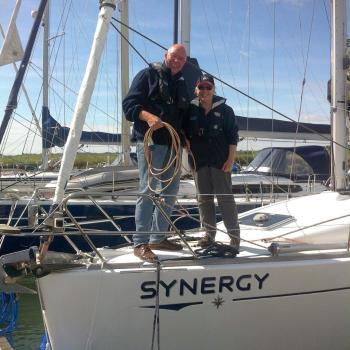

After France, and even the coast of Spain, Portugal is pretty sparsely populated with suitable stopping places for cruising yachts. So we found ourselves with some long hops to make to reach the next night’s berth. On the upside, we found that we were putting lots of miles behind us an the target of reaching Gibraltar by mid-September was starting to look easy. At 67 miles, the run from Leixos to Figuero do Foz was one of the longer ones and also one of the least eventful. The light wind was almost on the bow so the sails weren’t much help and, once again, the engine did all the work. It was an easy passage with a few dolphins for company for a while and “George” the autopilot doing the helming work for us. We talked briefly to a Canadian on a British flagged boat that we overtook named Onegin (apparently and disappointingly not pronounced One Gin) and agreed to meet up for a drink if we happened to arrive in the same port. Figueira da Foz is located on the Mondego river with the marina lying on the right bank a short way up the river conveniently placed for an easy walk into town. After a quick look around we had dinner on the boat and turned in for the night with another long day ahead of us.
Category: Uncategorized
Viana do Castelo to Leixoes
We left early in the morning before the swing bridge closed. It is left open at night but is closed to allow access to pedestrians after 0800 and only opened on request during the day. With 10 minutes to spare we retraced or steps of the previous Tuesday and passed the rock festival which was playing music even at that early hour. We managed some sailing but mostly with engine running and had a relatively uneventful trip until we approached Leixõs, when the heavens opened. As we crossed the commercial harbour the rain increased to a deluge and we were thoroughly soaked by the time we reached the marina at the back of the harbour. There was no answer on the radio and no one around to guide us. The reception pontoon was full so we moored up at the nearest convenient spot which was a rather rickety old pontoon which my foot went through as soon as I stepped off the boat. Apparently it was lunchtime which was why no one was around. while waiting for the marina office to re-open, we noticed a very battered Bavaria 40 at the end of our pontoon. Its spray hood was in tatters the deck was covered in lichen and it looked as if it had sunk and been salvaged: its name –“Phoenix.” It would take a lot of work to make that one rise from the ashes.

Impressive architecture, Porto

Impressive architecture, Porto

Central square, Old Porto

Big Towers, Porto
In the afternoon the rain eased and we took a stroll into Leixõs (pronounced something like Layshoise!) and grabbed a meal at a nearly empty restaurant.

14th August 2015 Porto
The reason for visiting Leixõs, apart from there being few stopping options on the Portuguese coast, was its proximity to Porto which we wanted to visit. We took a bus into Porto and then took a hop on-hop-off tourist bus around the city which is steeped in history (and port producing houses). The bus stopped on the east bank of the river Douro where all the port producers were located. After lunch, purchased from a riverside stall, we set off up the very steep hill leading to the Taylor’s Port emporium (one of) our favoured brands. Having puffed our way to the top of the hill, Taylor’s site was very reminiscent of a sherry Bodega or a Scotch Whiskey distillery – very pretty and well kept and not much activity as most of the work was done inland up the River Douro where the grapes are grown. We sampled some port, three varieties in all: Chip dry port, tawny and ruby only a sample of the different possibilities. I had no idea there were so many. After a very informative tour of the site which included information on what went into it and what makes a real vintage port, we made our way back down the hill to the bus. Completing the circuit back to where we started took us through the very picturesque old town by the river. By the time we reached Leixõs we were exhausted and fell into the nearest restaurant, who’s name I wish I could remember. It was extremely popular with the local Portuguese and the reason became apparent when we received the bill. Two sea bass and a couple of rounds of drinks came to 9 Euros per head. When we questioned the low price a Portuguese at a nearby table said that it was a flat rate of 9 Euros whatever you ate or drank. Outstanding!!

Old Porto from the East side of the River Douro


River Douro looking downstream

River Douro

River Douro Bridge

Old Porto

Old Porto
Baiona to Viana do Castello
By now, we were getting a little concerned at all the delays and we were determined to put some miles behind us so that we might reach Gibraltar by our target date of mid- September. We were up early for our run down to Viana do Castelo, the first stop in Portugal. After refuelling the boat we set off in quite murky conditions with a visibility of slightly less than 2 miles. The visibility improved as we went, but the wind was unfavourable – right on the bow, so it was motoring yet again. We made good time and overtook a larger French ketch who wished to know if his AIS (automatic identification system) was working. It wasn’t, which may have given him problems later as the visibility started to drop rapidly and we quickly ran into a fog bank which reduced the visibility to less than 100 metres at times. We had no option but to press on with a sharp lookout the radar on and a close watch for other boats on the AIS.
It was a good chance to try out the fog horn which we hadn’t had cause to use until now. It is a pump up version with a canister like an aerosol, but with a hand pump on the end. After a few pumps the release handle lets the compressed air through the horn, initially producing the traditional horn like sound, but fading to a strangled squawk as the pressure faded. Motoring on with a good lookout for other vessels and for the copious fishing buoys that were even harder to see in the murk and periodically sounding like a strangled duck we finally came close to the entrance to Viana do Castelo, but nothing was to be seen. We had to carry out some evasive manoeuvres to dodge fishing boats that were running for home, but saw none of them; the AIS was worth its weight in gold that day! Finally, with all the fishing boats well ahead of us, we made progress towards the river entrance, but nothing was to be seen. Motoring almost completely blind, it was a great relief when the breakwater appeared about 100 metres away and we made our way into the shelter of the river. Initially the banks of the river and the buoys marking the channel were very difficult to see but, mercifully, the visibility improved as we got further upstream until we were able to see the swing bridge into the marina. A call to the harbour master and the bridge swung open and it was with great relief that we moored up.
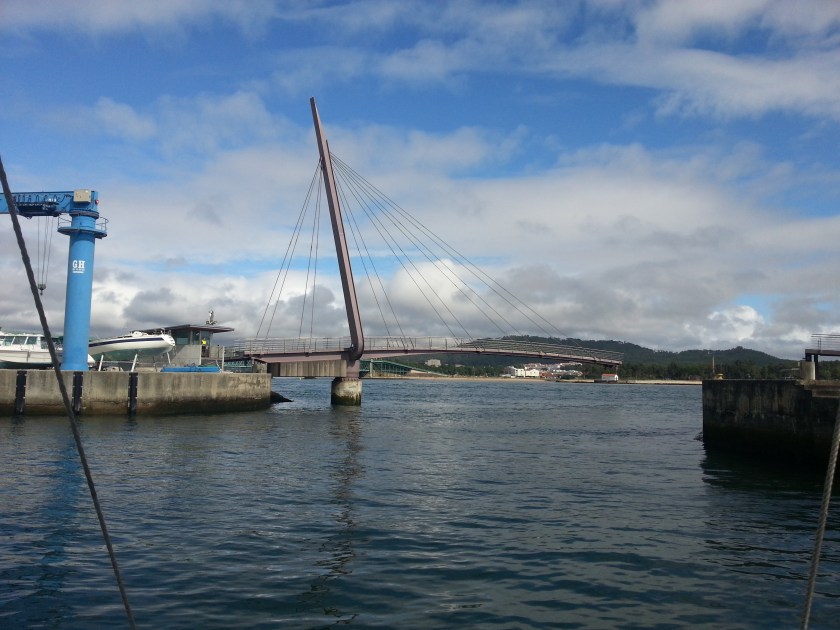
This was our first encounter with lazy line moorings, bow in and secured at the stern with lines fixed to the sea bed. The harbour master helped us in, but the bow-in mooring gave Jac a problem climbing on and off over the anchor. A friendly French couple, moored alongside stern in, saved the day by letting us use their boat as a stepping stone to the shore. After a wander around town followed by a meal of steak cooked in port, we retired to a hostelry, The Irish Bar (they get everywhere) which had the bonus of a good internet connection.
12th August 2015 Viana do Castello
We were running out of clean clothes so it was time for a washing run. The machines were a half mile from the boat on the other side of the marina across the swing bridge so this was going to take a while. Having started the washing we took a trip into town and went looking for a chandlery and to do some rubber-necking around the fishing port down the river. It is quite a pretty town and yet another with a rock festival going on. Having collected the washing we headed back to the Irish bar and used the internet to order some boat parts before having yet another hamburger and heading to bed.
Muros to Baiona

Island on route to Baiona

Island on route to Baiona

Island on route to Baiona

Approaching Baiona
We left Muros in a stiff breeze with a bit of a swell rolling in from the Atlantic but the wind dropped rapidly so we had to rely on the engine again. Despite that, it was an easy run in bright sunshine, so perhaps we had finally left the poor weather behind us. En-route we encountered some dolphins, which stayed with us for a while, the first that we
had seen since crossing Biscay. We also heard a “Mayday relay” from Vigo Radio, reporting a sinking sailing boat and asking for any nearby boats to assist. We checked the reported position on the chart, but the incident was over a hundred miles from us so there was nothing that we could do. Six and a half hours later we had covered the 38 miles to Baiona which was to be our last stopping place before Portugal. We moored up on the arrival pontoon which was around 200 metres from the shore so, in the absence of any guidance, we moved closer in to a much more convenient spot, behind “Riff Raff” a boat that we had previously encountered at Camariñas. They were planning on heading for the Canaries and joining the Atlantic Rally for Cruisers (ARC). After sampling the wares at a local hostelry we ate on the boat and resolved to spend the next day exploring Baiona.
10th August 2015 Baiona
Baiona turned out to be a fascinating place and, like many of the places we had stopped at, steeped in history. The town had been the first port of call for the Pinta, one of Columbus’s ships returning from his “discovery” of America. We went to stock up with groceries from Columbus Stores and saw Columbus’s bike and also went looking for a chandlery. Yacht chandlers seem to be pretty thin on the ground in Spain but we eventually found one that was open. It turned out that everything was closing early as it was a public holiday. Apart from the groceries we bought some new fender socks, a replacement light for one of the horseshoe buoys which had split and a doormat for the boat! In the evening, we walked up Columbus’s steps, (all 131 of them, we counted) to Columbus’s hamburger joint which was shut. However, the views were stunning so we decided to take some photographs. Unfortunately, the camera was on the boat so we walked back down the steps (still 131 of them) to the boat collected the camera and walked all the way back up again, by which time the restaurant was open. All the exercise was well worth it for the great views and a fantastic hamburger.

Baiona MarinaBaiona Marina from Columus’s Hamburger Bar

Synergy moored at Baiona

Baiona Marina from Columus’s Hamburger Bar

View from Columus’s Hamburger Bar
Camarinas to Muros

We left Camariñas early as the weather was fine and we made good speed motor siling for the first hour or so. However, the wind dropped just north of Cape Finisterra so we motor sailed with the genoa for the remainder of the route to Muros. We had our fair share of Atlantic swell on the beam, but it was a long swell so not particularly uncomfortable. Finally we passed the cape, south of which the weather was going to improve (Honest!) As often seemed the case, the wind picked up as we reached Muros making the arrival on the pontoon tricky. Shortly after we arrived Pedro, who was mentioned in the pilot book, arrived and was just as helpful as the literature led us to believe. He recommended that we moved into the inner harbour as we had moored in the fishing boat area and he said we should have a rough time there with boats coming and going all night. We took his advice and he helped us to move to a better berth and close the facilities. Muros is a lovely town and the Marina office provided all we could wish for, including a small, secluded garden, great showers and free coffee making facilities. The only downside was that we arrived in the middle of a rock concert with the accompanying musical diarrhoea playing at maximum volume until two in the morning.

Post Finisterre celebration

Post Finisterre celebration
8th August 2015 Muros
Morning broke to another windy day, but at least the music, if you could call it that, had stopped. We weren’t going anywhere in the conditions, but we were not too disappointed as we wanted to do more exploring. We wandered around the very pretty old town and stopped for lunch in a café. The town was busy with rock fans, although they must all have had cloth ears as the music was diabolical! During lunch we were entertained by a pipe band, (Celtic tradition is strong in Galicia) and followed the antics of an inebriated Zebra who was extremely entertaining!

Pipe band

Inebriated Zebra
In the afternoon we clambered up the hill to take a look at the church and explored the town. Returning to Synergy in the evening, we discovered that the wind had taken its toll of Jac’s towel which we had left drying on the guardrail, but it had now disappeared.

Church, Muros


Old Market, Muros

Interesting Fountain

Corme to Camarinas
After a very rocky and disturbed night we weighed anchor at 0930 and slipped up the Ria planning to reach Muros, past Cabo Finisterre where we were hoping for better weather. As usual it was not to be. The wind and swell again increased, but worse still, a sea fog came in which cut visibility down to less than half a mile with the view ahead even more obscured. With great bravery we ran away! As we ad only just passed the entrance to Ria in which Camariñas was located we turned around and made for there. As we cleared the open sea both the visibility improved and we arrived in the marina, built into the fishing harbour in bright sunshine. We were so glad that we had done so as Camariñas turned out to be a delightful spot. It is a very small but very well run marina operated by the local yacht club, the Club Nautica. The staff couldn’t be more helpful and the club restaurant was very good. We decided to look around the town and dined on octopus and patatas bravas at a waterfront restaurant. We were so taken with Camariñas that we wanted to stay another night and explore further. However, the following day looked good and with our recent experiences of poor weather, we decided to press on and try to round Cabo Finisterre where, we were assured, the weather would improve.

The harbour Camarinas

The harbour Camarinas

Fishing boat ashore Camarinas
A Coruna to Corme

Leaving A Coruna

Tower of Hercules, Coruna

Tower of Hercules, Coruna

Weather getting rough near Corme
Day dawned bright and sunny and the swell had eased so we planned to run to Camariñas in the South Spanish Rias. (Ria-ocean inlet a bit like a Scottish sea loch). However, the swell and wind picked up and a front arrived with driving rain so once again we changed plans and made our way to an anchorage in the little fishing port of Corme. After the battering in the swell we were pretty tired and couldn’t be bothered to go ashore in the tender. Besides which, we hadn’t used the anchor much and didn’t want to risk it dragging with no-one on board. Curry for dinner on the boat and hoping for better weather in the morning.

Coastline near Corme

Coastline near Corme

The achorage, Corme

Fishing rafts, Corme achorage
Viveiro to A Coruna
Finally a decent day. Together with the other boats who had been holed up in Viveiro, notably “Patience” and “Penelope III,” who we would encounter later, Jac and I took Synergy down the channel and the Ria out to sea. In a favourable wind, force 5 occasionally 6, we ran the 57 miles to A Coruña in just over 8 hours, sailing most of the way and touching well over 7 knots at times. Mooring up in the marina we were greeted by an Irish chap who worked there. Weird! The marina was well founded and run in a big sheltered harbour. We were making progress again! In the evening we took a stroll into town and found a great, but rather expensive restaurant just off the Plaza Maria Pita, a very attractive square where we dined on Paella and wine, Jac’s favourite.

Impressive Harbour Control Office at A Coruna

Back streets of Coruna

Church in Coruna

Plaza Maria Pia by night

Plaza Maria Pia by day
2nd August 15 A Coruña
We decided to spend the day in A Coruña doing some jobs around the boat. Somewhere to the south of the city a serious forest fire was burning and a plume of smoke was rising. In the afternoon a succession of Canadair water bombers arrived, scooping water from outside the harbour and later from within to drop onto the fire which seemed to have been extinguished by the following day.
3rd August 15 A Coruña
The weather had deteriorated once again so we stayed put and decided to go hunting for a yacht chandler. We assembled the bikes and made our way across the city to catch the shop just before it closed for lunch. Having purchased some stainless steel screws, some water purifier and a new kill chord for the outboard motor. After completing some boat maintenance work and having an evening meal on the boat we turned in for a very rocky night as the swell was penetrating deep inside the harbour.
4th August 15 A Coruña
Day dawned with the Atlantic crashing over the massive sea wall and we were not brave enough to venture out in those conditions. Another day was spent sightseeing and trying to sort out a Spanish mobile phone to try to cut the costs of phoning the UK. Rather than slog back into town we thought we would leave it until we reached Bayona further on.
Luarca to Viveiro

View upriver, Viveiro

Jac at Viveiro

The marina, Viveiro
After the large swells entering the harbour during the night, we decided to take a look at the conditions outside before we ventured on our way again. Jac and I took the tender across to the harbour wall and clambered up the rusty and crab infested ladder to see what was happening. Whilst still a bit rough, the conditions looked easier than the previous day we decided to give it a try and set off planning to head for Ribadeo. Unlike the previous 2 days the conditions improved as we progressed so we once again altered our plan to bypass Ribadeo and carry on to Viveiro, a distance of 55 miles. We stayed close to a headland which gave us some protection from the Atlantic swell, but steady force 5 wind was forecast to increase to 7 or so later. And indeed it did. As we approached the entrance to the Ria de Viveiro, out of the protection of the land the wind rapidly increased to Force 7 gusting 8 with an accompanying rough sea. Fortunately we didn’t have to endure this for long as we altered our westerly course to southerly as we made our way into the Ria and the shelter of Viveiro Marina. The staff there were outstanding with helpers on the pontoon to assist us in the quite blustery conditions.
We had had a good run with quite a lot of sailing and we even managed to turn off the engine a maintain 6 knots (ish) under sail for a while. However we had to mourn the loss of Jac’s baseball cap, known as the Virgin hat as that was its logo. Jac was relly quite upset at losing her virginity!
29th July 15 Viveiro
One look out of the boat in the morning revealed a grey, drizzly day with very poor visibility, so we weren’t going anywhere. Our next stopping point was A Coruña, round the northwest tip of Spain where we hoped the weather would improve, but it was nearly 60 miles away so the trip would take all day. We needed much better weather than was on offer so we had to wait a bit. Bert had some shopping to do, so Jac and I went to explore the old town which turned out to be a very pretty place with stacks of history. We found a good restaurant, ” The Meson Imperial” in the main pedestrian street which had great octopus, friendly staff and good internet. Wonderful!
30th July 15 Viveiro Again
Woke up to the same weather. We were wondering if we were ever going to see the sun again. The rain in Spain was mainly down our necks! However, everyone we spoke to said that the weather would improve once we reached A Coruña. (Oh yeah!) Bert was planning to stay with us until A Coruña, but the delays meant he had to leave us at Viveiro, which was easier said than done. Viveiro is a little remote and none of the public transport options met our needs. The only solution was to hire a car, but the only car rental company, Multi-Rent, was 15 km out of town. A quick phone call and all was arranged, with the car being delivered to the marina that evening.
Time to relax and another trip into town sightseeing in pouring rain. In the back streets, among other things, we found a little corner where, presumably, a natural spring emerged connected to running taps where the locals were filling plastic water bottles. It seemed to be a substitute for bottled water from the shops. You wouldn’t find that in Milton Keynes.

Back Streets of Viveiro

Natural Spring

Natural Spring

Jac in the wet

Aftermath of a good party or advertisment for a jeans shop

Back Streets of Viveiro

Ornate bicycle

Street sign that appealed to our juvenile sense of humour
In the evening we went to collect the car only to be told by the harbour master that the car rental company could not deliver and we would have to go and collect it from their office. Once again the marina staff were superb and the handyman, who turned out to be a qualified molecular biologist, gave me a lift to the office, refusing to take anything for his trouble. At the car rental office I was met by the most miserable, uncooperative bastard that you could hope to encounter and I took possession of a very battered Kia something. Having taken the car back to the marina, we walked into town and had a farewell meal with Bert at the Meson Imperial.
31st July 15 Viveiro Yet Again
Still raining. We set off for A Coruña airport in our rent-a-wreck, a pleasant hour and half drive. After a coffee in the airport café with Bert he caught the flight to Bristol and Jac and I drove to Santiago de Compostela to do some sightseeing. Santiago is a place of Christian pilgrimage and has been for hundreds of years. The old town is crowned by the magnificent cathedral of St James (Saint Iago) who is supposed to be buried there.

Views of the Cathedral of St Iago de Compostella

Views of the Cathedral of St Iago de Compostella

Views of the Cathedral of St Iago de Compostella

Views of the Cathedral of St Iago de Compostella

Views of the Cathedral of St Iago de Compostella

Views of the Cathedral of St Iago de Compostella

Views of the Cathedral of St Iago de Compostella

Views of the Cathedral of St Iago de Compostella

Views of the Cathedral of St Iago de Compostella

Views of the Cathedral of St Iago de Compostella

Views of the Cathedral of St Iago de Compostella

Views of the Cathedral of St Iago de Compostella
After a couple of hours exploring we drove back to Señor Misery at Multi-Rent, who came outside and tried to indicate that a slightly deflated tyre was my fault. He finally said that there would be no charge, but I was so suspicious of him that I phoned the credit card company to ensure that no further bills from Multi-rent would be processed. Took a taxi back to Synergy for a meal of canned sausages and lentils!
Cudillero to Luarca

Almost dry river in Luarca

Almost dry river in Luarca
We left Cudillero aiming to get all the way to Viveiro, a sheltered marina deep inside the Ria de Viveiro close to the most westerly tip of Spain. However, the light wind rapidly grew in strength and, coupled with a 4 metre cross swell, the rough motion rapidly became tiresome. We changed the plan to head to the closer port of Ribadeo, but even this became impractical in the worsening conditions. After three hours or so of increasing discomfort we opted to dive into Luarca, a convenient fishing port en-route. A massive harbour wall protected the outer harbour where the visitor’s berths were placed, but there were only four of them and we had to wait for an Irish flagged boat to depart before we could manoeuvre into position. The mooring system was, again one that we had not previously encountered. Four substantial mooring buoys were anchored to the sea bed to tie up the bow line, but the stern had to be tied to the harbour wall by rowing a line ashore. Fortunately we had bought a 200 metre line at the 2014 Southampton boat show in anticipation of shore moorings in the Mediterranean. Bert did the honours of taking the line ashore and clambering up the 40 feet or so of ladder to tie off on the bollard. all secure, we nevertheless had a rocky night of it as the big swell came into the outer harbour.

Moored next to us was “Snorkel” a much smaller boat that had taken a longer route across Biscay and was staying in Luarca for a day or two to secure their mast which had worked loose. They had to do some serious sailing as their engine/fuel tank combination could only give them 12 hours motoring at speeds as low as 3 knots. We later watched their progress on the AIS with interest and they reached the Mediterranean long before we did.
During the afternoon, we took the tender into the town, which was much bigger than it looked with a pretty inner fishing harbour. We found a good internet connection at a bar called “La Gaviota” where we also had some great tapas. On the way back Bert managed to lose the kill chord for the outboard motor.


 Sailing Synergy